Drop 01 — accessioned late July5% of net sales to the Cornell Lab of OrnithologyFree US shipping over $95Designed, not generatedDrop 01 — accessioned late July5% of net sales to the Cornell Lab of OrnithologyFree US shipping over $95Designed, not generated
LARKFEN FIELD GUIDEPLATE 00 · FRONT MATTER
Field Guide · Est. on the local patchSPECIMEN ARCHIVE
Wearable field guides. For the observant.
Larkfen is a field-guide outfit. We observe a bird, measure it, draw it by hand,
verify every claim against a source — then issue the study as a plate, a poster, an
edition print, and the field goods that carry its record. Correct binomial. Field
marks you could call. Real numbers.
Every plate ships as a field garment — the full study printed large across the back, a pocket-sized accession label at the chest. Hover (or drag) to read the print under the loupe; tap the inset to flip front ⟲ back. Three studies, three colorways.
Hover / drag either image to zoom · tap inset to flip
A faithful read of the garment — the full study plate is the back print, a small accession label sits at the chest. No compositing, no invented detail.
THE PLATE SHIPS LARGE · THE TEE CARRIES THE RECORD
LARKFEN FIELD GUIDEPLATE 01 · THE INDEX
§ Front matter / register
The plate index
Every study in the archive, in order of accession. Each plate is a record first — the field goods it produces are noted in the last column.
PLATE 01 · the grammar of a study · on the Bay colorway
§ Anatomy of a plate · A → E
A
The top rail
Every plate opens with LARKFEN FIELD GUIDE and a plate number — the same rail that frames this whole site.
B
Name & binomial
Engraved species name over its italic Latin binomial. The scientific name is checked first and changed last.
C
The data block
Mono label/value rows — WING CHORD · HABITAT · STATUS — set as an instrument readout, not decoration.
D
Band number
An accession like LF-PATCH-001 ties the plate to its field goods. The footer rule closes the record.
E
Field-mark callouts
Diagnostic marks are flagged head → tail — crest, mask, cone bill — the features you would actually call in the field, never decoration.
RailGuide + plate nº
BinomialGenus · species
Data block3–5 mono rows
AccessionLF- band nº
SourceCornell · IUCN
Verified100% marks
READ THE PLATE · THEN READ THE BIRD
LARKFEN FIELD GUIDE · LF-LIFE-001PLATE 03 · NORTHERN CARDINAL
PLATE 03 · Cardinalis cardinalis · dark ink on cream
§ Field marks · head → tail
CrestTall, erectile crown feathers — raised in song and alarm, lowered at rest. Diagnostic at a glance.
Black maskJet-black face around the bill, eyes and chin — bold in the male, reduced to a dusky smudge in the female. Never blue.
Cone billShort, very thick orange-red seed-cracking bill; juveniles show a grey-to-black bill.
Plumage ♂Brilliant red over the whole body — wings, tail and crest all red.
Plumage ♀Pale warm brown with red tinges in wings, tail and crest — same shape, quieter colour.
TailLong, often cocked and held high while perched.
Why it is red
Diet paints the bird
The red is carotenoid pigment the cardinal cannot make — it has to eat it, in berries and fruit. A brighter male is, quite literally, a better-fed male; the colour is an honest signal of foraging skill.
Pigment
dietary carotenoids
Length
21–23.5 cm
Wingspan
25–31 cm
AOU
NOCA
Unusual fact
Both sexes sing
Unlike most North-American songbirds, the female cardinal sings — often from the nest, sometimes a longer, more complex phrase than the male's. Pairs counter-sing to hold a territory together year-round.
Song
both sexes
Status
perm. resident
Clutch
3–4 eggs (2–5)
Oldest banded
~15 yr 9 mo
Tell it apartvs Pyrrhuloxia — grey body, stubby yellow billvs Summer Tanager — no crest, longer pale billvs Scarlet Tanager — red body, black wings & tailvs House Finch — no crest, streaky brown flanks
CREST · BLACK MASK · RED CONE BILL = CARDINAL
LARKFEN FIELD GUIDEPLATE 04 · THE PLATES
§ Species accounts
Six plates, on the cloth they print on
Each account is a plate before it is a product — the bird drawn from a record, with the measurements we used to draw it set alongside, on the garment colorway it actually prints on.
03 species 03 issues
PLATE 01LF-PATCH-001
Great Blue Heron
Ardea herodias
Wing chord
430–490 mm
Wingspan
167–201 cm
Status
resident
Open study → $44
PLATE 03LF-LIFE-001
Northern Cardinal
Cardinalis cardinalis
Length
21–23.5 cm
Wingspan
25–31 cm
AOU
NOCA
Open study → $44
PLATE 02LF-VSP-001
Common Raven
Corvus corax
Wing chord
350–460 mm
Wingspan
116–150 cm
Brain rel.
pigeon ‹ crow ‹ raven
Open study → $44
OBSERVED & DRAWN · LARKFEN FIELD GUIDE
LARKFEN FIELD GUIDEPLATE 05 · FEATURED STUDY
Study Nº · LF-VSP-001The reasoning corvid
A bird that plans.
Corvus corax
We drew the raven the way you would log it in the field, then did the part most merch skips: the data. Relative brain size, charted honestly — pigeon to crow to raven — because the claim has to survive someone who actually knows the bird. There is no clean EQ number to put on a shirt, so we show the ranking, not a fabricated figure.
FIELD MARKS — wedge tail vs. the crow's fan · shaggy throat hackles · heavy bill · a croaking gronk · 15–30+ described call types.
Relative brain size — ranking only
Pigeon
Crow
Raven
Relative ranking, not to scale. No precise encephalization figure is published for a single shirt claim.
CORVUS CORAX · WING CHORD 350–460 MM · MASS 690–1,630 G
LARKFEN FIELD GUIDEPLATE 06 · COMPARATIVE MEASUREMENTS
§ Mensural data · the three flagship studies
Measured side by side
Every figure below is pulled from primary references — Cornell Birds of the World, Cornell All About Birds, Audubon — and redlined before print. Ranges, not means: a wild bird is a range.
3 species · 9 metrics Verified 2026-06-14
Body Mensuration · 3 SpecimensSHARED-AXIS RANGE · LF-VIZ-MEASURE
Shared-axis size comparison of the three flagship specimens. Total length: Great Blue Heron 97 to 137 centimetres, Common Raven 56 to 69 centimetres, Northern Cardinal 21 to 23.5 centimetres. Wingspan: heron 167 to 201 centimetres, raven 116 to 150 centimetres, cardinal 25 to 31 centimetres. Body mass: heron 2000 to 3600 grams, raven 690 to 1,630 grams, cardinal 42 to 48 grams.
Specimen keyGreat Blue HeronCommon RavenNorthern Cardinal
Total Lengthbill tip → tail tip · cm
HeronArdea herodias97–137cm
RavenCorvus corax56–69cm
CardinalCardinalis cardinalis21–23.5cm
0306090120150
Wingspantip → tip · cm
HeronArdea herodias167–201cm
RavenCorvus corax116–150cm
CardinalCardinalis cardinalis25–31cm
0306090120150180210
Body Massadult · g
HeronArdea herodias2000–3600g
RavenCorvus corax690–1,630g
CardinalCardinalis cardinalis42–48g
01000200030004000
Wingspan to scale · 0 → 210 cm
Great Blue Heron201 cm
Common Raven150 cm
Northern Cardinal31 cm
Bar = published min–max range; ticks mark the extremesAxis is per-metric, shared across all three specimens · Data: Cornell Lab / IUCN
§ Conservation status & population trend · the three flagship studies
Status & TrendLF-PATCH-001
LCLeast Concern
LC · NT · VU · EN · CR
Great Blue Heron — N. AmericaStable
±0%net / decade
197019952019
DeclineIncrease
Source · USGS BBS / PIFWingspan 167–201 cm · Mass 2.0–3.6 kg · largely resident
Status & TrendLF-VSP-001
LCLeast Concern
LC · NT · VU · EN · CR
Common Raven — Western / NorthernIncreasing
+1.4%per year
196619932019
DeclineIncrease
Source · USGS BBS 1966–201956–69 cm · Wingspan 116–150 cm · resident W/N
Status & TrendLF-LIFE-001
LCLeast Concern
LC · NT · VU · EN · CR
Northern Cardinal — Eastern USIncreasing
+0.5%per year
196619932019
DeclineIncrease
Source · USGS BBS 1966–201921–23.5 cm · Mass 42–48 g · permanent resident
Key · how to read this graphic
IUCN Red List status
LCLeast Concernlow risk
NTNear Threatenedwatch
VUVulnerableat risk
ENEndangeredhigh risk
CRCritically Endangeredextreme
Population trend · diverging
Increaserising indexslate
Stableno net changesage
Declinefalling indexoxblood
No datainsufficient survey≠ zero
Magnitudedarker / longer = stronger% · yr
Metric
Great Blue HeronArdea herodias
Common RavenCorvus corax
Northern CardinalCardinalis cardinalis
AOU code
GBHE
CORA
NOCA
Order · Family
Pelecaniformes / Ardeidae
Passeriformes / Corvidae
Passeriformes / Cardinalidae
Culmen / bill
123–152 mm
long, heavy ⚑
stout red cone
Clutch
3–5 eggs (2–6)
4–6 eggs (3–7)
3–4 eggs (2–5)
Incubation
~26–29 d · both sexes
~18–21 d · female
11–13 d · female
Oldest banded
~24 yr 6 mo
~22 yr
~15 yr 9 mo
⚑ Flagged for redline — precise raven culmen in mm is not cleanly published; held qualitative rather than fabricated. Cardinal & raven wing-chord in mm sit in the Birds of the World appendices and are pending verification. Heron taxonomy follows the modern AOS/IOC placement in Pelecaniformes (older guides list Ciconiiformes). Size, wingspan, mass and conservation status are charted above. Data: Cornell Lab / IUCN.
RANGES NOT MEANS · A WILD BIRD IS A RANGE
LARKFEN FIELD GUIDEPLATE 07 · FIELD GOODS
§ The back print · spread by colorway
The plate is the back print
Each study prints full-size across the back of its garment, on the colorway drawn for it — heron and cardinal on Comfort Colors Ivory, the raven on washed Pepper. A pocket spec-label sits at the chest. Same record, two faces.
Back · full plate Front · spec-label
BACK · FULL PLATELF-PATCH-001
Great Blue Heron
Ardea herodias
CC Ivory $44
BACK · FULL PLATELF-VSP-001
Common Raven
Corvus corax
CC Pepper $44
BACK · FULL PLATELF-LIFE-001
Northern Cardinal
Cardinalis cardinalis
CC Ivory $44
Read the back print under the loupe in the field-issue device at the top of the page — flip to the chest label, zoom either face. No compositing, no invented detail.
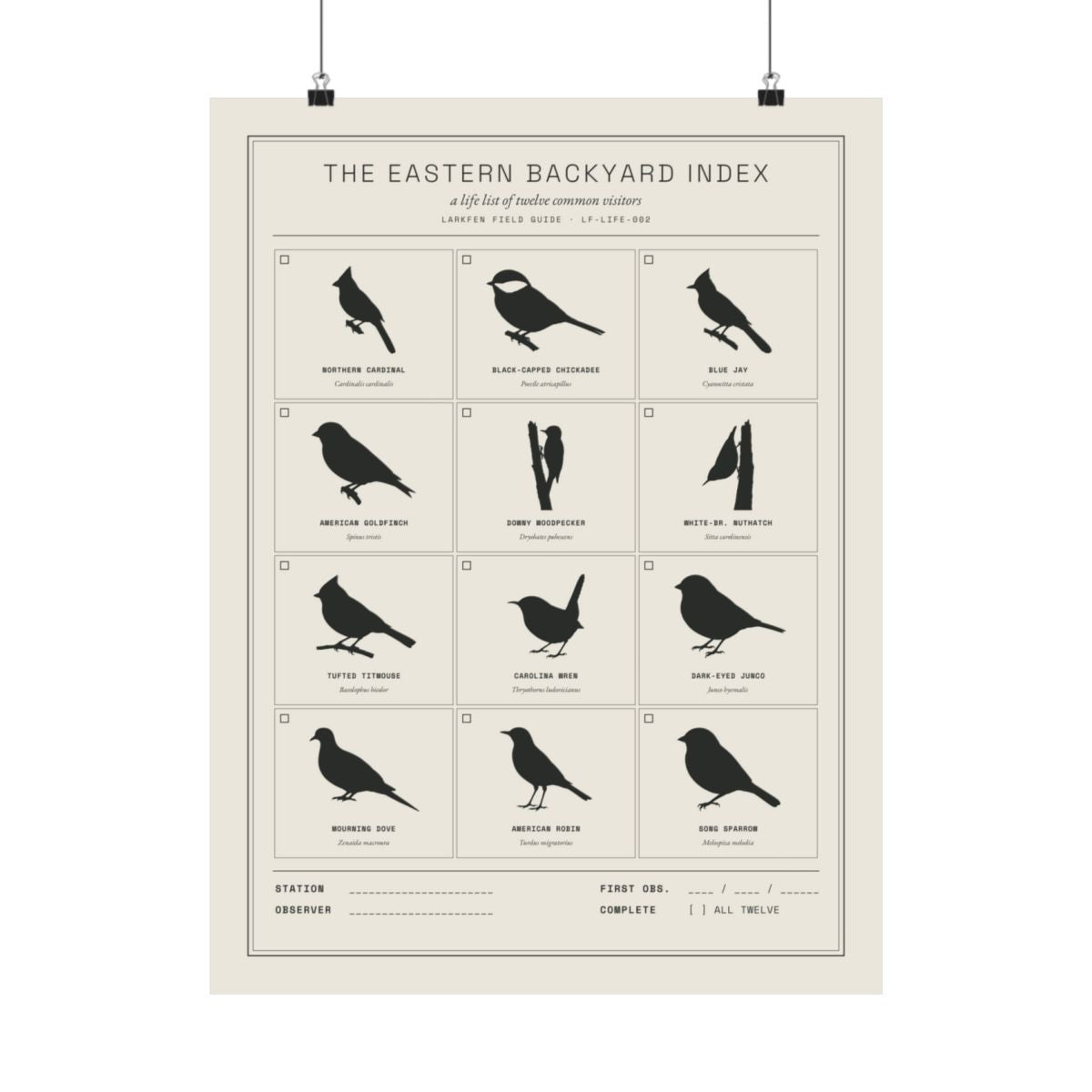
The wall study · LF-LIFE-002
Eastern Backyard Index
Twelve common visitors · the life-list grid
The full registry, printed: twelve verified binomials in a hand-set grid, with a check-box waiting for your own date. The poster every Larkfen room is built around.
THE PLATE SHIPS LARGE · THE TEE CARRIES THE RECORD
LARKFEN FIELD GUIDEPLATE 08 · SIMILAR SPECIES
§ Confusion pairs · separating the near-twins
Tell them apart
The core work of any field guide is separation — the marks that split a bird from the species it is mistaken for. These are the calls our flagship studies are drawn to make.
3 pairs Diagnostic marks
PAIR 01 · CORVIDAECORA / AMCR
Common RavenCorvus coraxvsAmerican CrowC. brachyrhynchos
SizeRaven 56–69 cm, much larger than the crow (~40–53 cm)
TailRaven shows a wedge / diamond; crow's tail is squared and fans out
ThroatRaven has shaggy hackles; the crow's throat is smooth
Key markCrest + black face mask + heavy red cone bill = cardinal
vs PyrrhuloxiaStubby yellow parrot-like bill, gray body with red trim; SW range
vs Summer TanagerAll rose-red, no crest, longer thin pale bill
vs Scarlet TanagerMale has black wings & tail; cardinal is uniform red
FemaleWarm brown with red tinges — still crested, red-orange bill
SEPARATION IS THE WHOLE JOB · CALL THE MARK
LARKFEN FIELD GUIDEPLATE 09 · RANGE & LEGEND
PLATE 01b · wetland margin transect · forage zone
§ Range key
Read the patch.
The transect maps a single wetland margin from open water to mudflat — the half-mile where the heron stands and waits. The range key reads the same on every Larkfen plate.
Residentpresent year-round on the patch
Breedingpresent in the nesting season
Migrantpassing through on passage
The transect is the local patch; the seasonal map below reads the continental range on the same legend — and teaches that absent is not the same as no data.
Ardea herodiasGreat Blue Heron · seasonal range
Residentyear-round
Breedingsummer only
Nonbreedingwinter only
Passagemigration only
Rarevagrant
No datanot surveyed
STATION MARKER · WETLAND MARGIN TRANSECT · FORAGE ZONE
LARKFEN FIELD GUIDEPLATE 10 · METHOD
§ How a plate is made
Four passes
From observation to print. The whole point of the brand lives in this sequence — designed, not generated.
Pipeline 04 passes
PASS 01
Observe
It starts as a record on the patch — the bird logged, the diagnostic marks noted in the order you would actually call them.
PASS 02
Measure
Real measurement ranges — wing chord, length, wingspan, mass — pulled from primary references before a line is drawn.
PASS 03
Draw
The plate is built by hand around what separates the bird from its near-twins, then typeset as an instrument readout.
PASS 04
Verify
Every claim is checked against a source and redlined. Only then does the plate become a tee, a poster, or an edition.
Before · first draft
BinomialCarduelis tristis
WoodpeckerPicoides pubescens
Heron mass~5 kg (guess)
After · redlined
GoldfinchSpinus tristis
Downy Wpr.Dryobates pubescens
Heron mass2.0–3.6 kg
OBSERVE · MEASURE · DRAW · VERIFY
LARKFEN FIELD GUIDEPLATE 11 · THE INDEX REGISTRY
§ Eastern Backyard Index · LF-LIFE-002
Twelve common visitors
The life-list registry behind the poster — twelve verified binomials, in current taxonomy. Check them off as you find them on your own patch.
12 species Archival 18×24
Nº
Common name
Binomial
☐
01
Northern Cardinal
Cardinalis cardinalis
☐
02
Black-capped Chickadee
Poecile atricapillus
☐
03
Blue Jay
Cyanocitta cristata
☐
04
American Goldfinch
Spinus tristis
☐
05
Downy Woodpecker
Dryobates pubescens
☐
06
White-breasted Nuthatch
Sitta carolinensis
☐
07
Tufted Titmouse
Baeolophus bicolor
☐
08
Carolina Wren
Thryothorus ludovicianus
☐
09
Dark-eyed Junco
Junco hyemalis
☐
10
Mourning Dove
Zenaida macroura
☐
11
American Robin
Turdus migratorius
☐
12
Song Sparrow
Melospiza melodia
☐
LF-LIFE-002 · the wall study
LOG AS YOU FIND THEM · COMPLETE [ ] ALL TWELVE
LARKFEN FIELD GUIDEPLATE 12 · GLOSSARY
§ Terms of the field · topography & convention
A glossary of field terms
The vocabulary every data block on this site is built from — the parts of a bird, the standard measurements, and the molt conventions. Defined once, used everywhere.
16 terms Sourced, not invented
Wing chord
Standard wing measurement: the wing bent at 90°, from the wrist (carpal) joint to the tip of the longest primary. Used to compare species and subspecies.
Culmen
The dorsal ridge of the upper mandible, measured from the feathering to the bill tip — the standard bill-length metric.
Supercilium
The "eyebrow" stripe running from the bill base, above the eye, toward the rear of the head; distinct from the eyestripe.
Gorget
A distinctly coloured throat patch — classically the iridescent throat of a hummingbird.
Primary projection
How far the primaries extend beyond the longest tertials on the folded wing — a key structural ID clue.
Eclipse plumage
A duller, seasonal plumage worn by species that otherwise have a bright breeding dress — notably male ducks after breeding.
Hackles
Erectile, often elongated feathers along the neck and throat — for example the shaggy throat hackles of the Common Raven.
Malar stripe
A "moustache" line of feathers running from the bill base down along the edge of the throat.
Nape
The back of the neck, where the crown colour meets the mantle.
Lores
The areas on each side of the face between the bill base and the front of the eye.
Vent
The region between the belly and the undertail coverts.
Tarsus
The most conspicuous (lower) segment of a bird's leg, from which the toes spring — a standard measurement.
Rectrices
The long, stiff flight feathers of the tail (singular: rectrix).
Primaries
The outermost flight feathers, attached to the "hand"; the visible "fingers" in soaring corvids and raptors. Numbered distally, P1 (inner) → P10 (outer).
Prebasic / prealternate molt
Humphrey-Parkes terms: the prebasic molt produces basic (non-breeding) plumage; the prealternate molt produces alternate (breeding) plumage.
Crest
Elongated, often erectile crown feathers raised in display — as in the cardinal, Blue Jay and titmouse.
DEFINE THE TERM · THEN MEASURE THE BIRD
LARKFEN FIELD GUIDEPLATE 13 · THE STANDARD
The Larkfen Standard
Designed, not generated.
Anything can put a bird on a shirt. The line we hold is accuracy and craft — the difference between a graphic and a study.
01
Correct binomial, every time
The scientific name is checked first and changed last. Spinus tristis, not the retired Carduelis; Dryobates, not Picoides. If it is on a Larkfen piece, it is current.
02
Field marks you could call
We draw the diagnostic marks — the wedge tail, the throat hackles, the S-curved neck in flight — the details that separate a bird from its near-twins at real distance.
03
Real numbers, honestly set
Measurements and ranges come from sources, never invented for the layout. Where no clean figure exists — the raven's brain — we show a ranking, not a number.
04
A check-box waiting for a date
Every life-list piece leaves room for your own record. The plate is finished; your sighting is the part only you can add.
REDLINE ACCEPTED · LAST VERIFIED 2026-06-14
SOURCES · CORNELL ALL ABOUT BIRDS · BIRDS OF THE WORLD · IUCN
LARKFEN FIELD GUIDEPLATE 14 · LITERATURE CITED
§ Authorities · the sources behind the numbers
A guide lists its authorities
Every figure on a Larkfen plate is traceable. These are the references the studies are checked against — and changed by — before anything is printed.
Last accessed 2026-06-14
Cornell Lab — All About Birds
Life histories, identification, size & mass ranges for all six studies.
acc. 2026-06-14
Cornell Lab — Birds of the World
Species accounts & appendices — e.g. grbher3 (heron), norcar, range maps.
acc. 2026-06-14
IUCN Red List
Conservation status & population trend per species — all currently Least Concern.
acc. 2026-06-14
National Audubon Society — Field Guide
Behaviour, voice and field-mark corroboration for the flagship accounts.
acc. 2026-06-14
AOS / AOU Check-list
Current binomials, taxonomic order, and the four-letter alpha codes (GBHE / CORA / NOCA).
acc. 2026-06-14
USGS Bird Banding Laboratory
Longevity records — oldest banded heron (~24 yr 6 mo), cardinal (~15 yr 9 mo).
acc. 2026-06-14
Partners in Flight
Global population estimates and Breeding Bird Survey trend figures.
acc. 2026-06-14
Where sources conflict — heron population spans ~700,000 (PIF) to a much wider IUCN band — Larkfen prints the figure qualitatively rather than a single contested number. Items still pending verification are flagged ⚑ on their plate, never quietly invented.
TRACEABLE · CITED · LAST VERIFIED 2026-06-14
LARKFEN FIELD GUIDEPLATE 15 · CONSERVATION
5%
Five percent of net sales to the Cornell Lab of Ornithology.
The birds make the work possible, so they get a cut of it. 5% of net sales supports the research, monitoring and open data the whole hobby quietly runs on.
PartnerCornell Lab of Ornithology
GIVING BACK TO THE PATCH · SINCE DROP 01
LARKFEN FIELD GUIDEPLATE 16 · FIELD NOTES
Field Notes · the dispatch
First look at every plate.
Drop 01 is accessioned late July. Join the field notes for early access, new specimen studies, and the occasional note from the patch.
THE LOCAL PATCH · LARKFEN FIELD GOODS
FIELD DISPATCH
The Digital Field Guide to the Wetland Transect
A hand-drawn, illustrated guide to the marsh transect — the same source studies behind the plates. Join the field log and we'll send it to your inbox, plus first access (and a founding-collector price) on the first print run.
One good bird per dispatch. No spam, unsubscribe anytime.
Logged ✓
You're on the field log. Your field guide is ready — grab the PDF below, and watch your inbox for the first-print invitation just behind it.