Drop 01 — accessioned late July5% of net sales to the Cornell Lab of OrnithologyFree US shipping over $95Designed, not generatedDrop 01 — accessioned late July5% of net sales to the Cornell Lab of OrnithologyFree US shipping over $95Designed, not generated
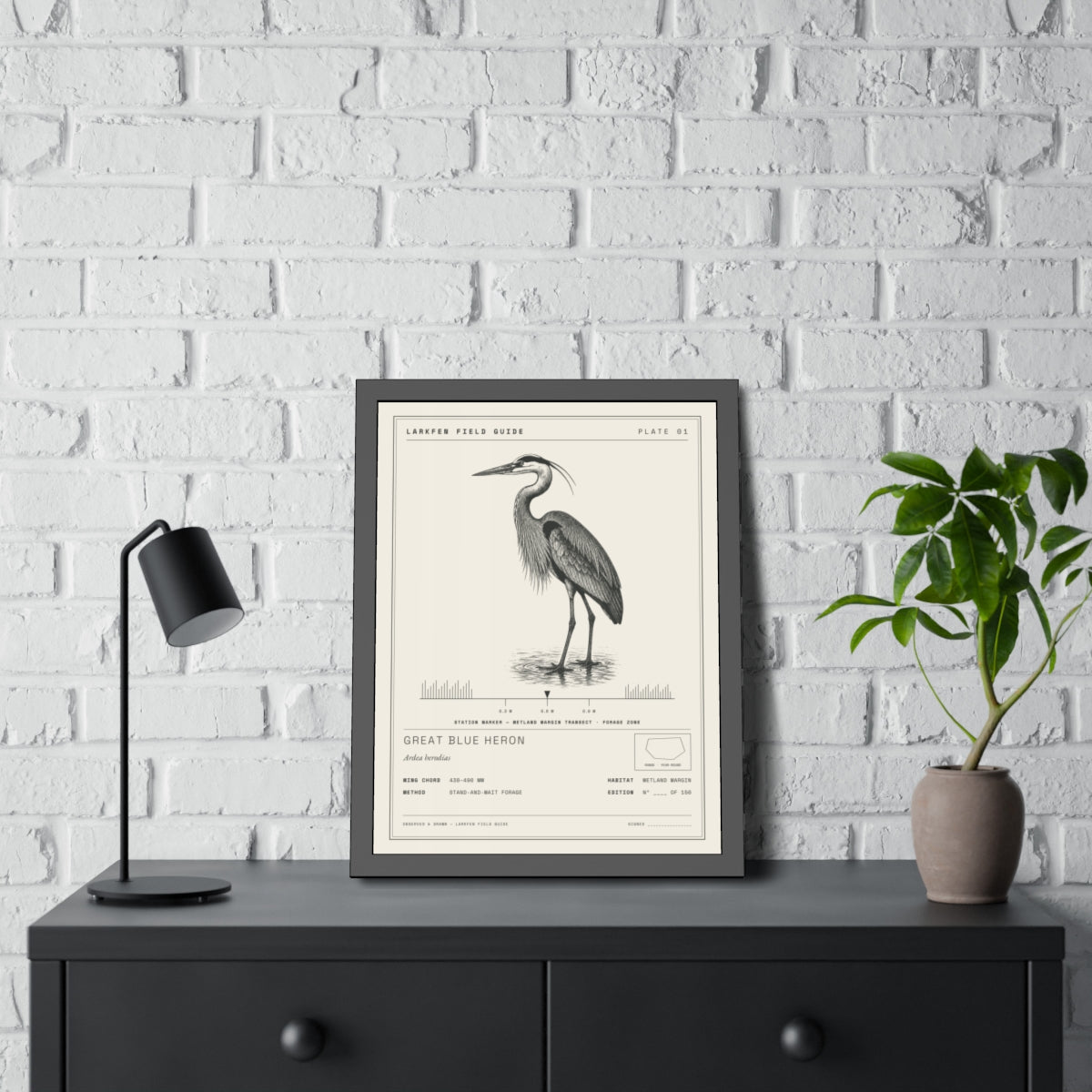
The flagship heron, plotted the way a field station would — standing on a transect,
a measured line across the wetland margin, with a station-marker scale beneath. The largest piece in the
guide, framed and numbered to 150. The full account behind the bird lives in the Great Blue Heron study.
CLASS WALL EDITION · FRAMED PRINT · EDITION OF 150 · BAND NO. LF-PATCH-002
THE PLATE SHIPS LARGE · THE WALL CARRIES THE RECORD
LARKFEN FIELD GUIDE · LF-PATCH-002PLATE 01a · ON THE WALL
§ The edition, in the room
The whole bird, on the wall
An archival print of the heron transect, dark-framed and matted. Hover (or drag) to read the plate under the loupe; tap the inset to flip between the two rooms it was photographed in.
Hover / drag either image to zoom · tap the inset to flip room
The tee carries the record at the chest; the framed edition is where the full study ships large.
Same plate, sized for the wall and numbered by hand.
THE WALL EDITION · A LARKFEN COLLECTION · THE LOCAL PATCH
LARKFEN FIELD GUIDE — Edition & speciesPLATE 01b · THE RECORD
§ The edition, the species, the transect · four-block lattice
Everything behind the print
The framed edition carries the same verified record as the study. Every figure pulled from primary references and redlined before it ships.
4 blocks · A–D Verified 2026-06-14
AThe edition
The print
Format
framed archival
Edition
150, numbered
Subject
heron · transect
Frame
dark wood · matted
Signed line
Nº __ of 150
BThe species
Verified
Length
97–137 cm
Wingspan
167–201 cm
Mass
1.82–3.6 kg
Wing chord
430–490 mm
Method
stand-and-wait
CThe transect
The measured line
What it is
a habitat line
Reads
open water → shore
Station scale
0.3 / 0.6 / 0.9 m
Forage zone
shallow margin
Status
resident · year-round
DObservation & provenance
The sources
Sources
Cornell · BoW · IUCN
Transect
schematic effort
Verified
2026-06-14
Redline
☑ accepted
Forage effort is qualitative, drawn from habitat accounts — not a field-measured budget.
Body mensuration · the bird on the plateSHARED-AXIS RANGE · LF-VIZ-MEASURE
Specimen keyGreat Blue HeronCommon RavenNorthern Cardinal
Total lengthbill tip → tail tip · cm
HeronArdea herodias97–137cm
RavenCorvus corax56–69cm
CardinalCardinalis cardinalis21–23.5cm
0306090120150
Wingspantip → tip · cm
HeronArdea herodias167–201cm
RavenCorvus corax116–150cm
CardinalCardinalis cardinalis25–31cm
0306090120150180210
Body massadult · g
HeronArdea herodias2000–3600g
RavenCorvus corax690–1,630g
CardinalCardinalis cardinalis42–48g
01000200030004000
Wingspan to scale · 0 → 210 cm
Great Blue Heron201 cm
Common Raven150 cm
Northern Cardinal31 cm
Bar = published min–max range; ticks mark the extremesAxis is per-metric, shared across all three specimens · Ranges not means · verified 2026-06-14 against Cornell · BoW · IUCN
The wall edition fixes one plate; the bird behind it works the patch every month. Breeding begins early — February–March on a temperate eastern margin — in colonial stick rookeries; presence peaks with the spring colony. (Months indicative, not locality-exact.)
12-month grid J → D
Phenology · J F M A M J J A S O N D
Phase
J
F
M
A
M
J
J
A
S
O
N
D
PresentEncounter freq.
BreedingNest active
EggsIn clutch
MigrationN. pop. passage
Intensitylowhigh
Absent (recorded zero)
No data
Reading the grid. Cell shade is an ordinal bin (eBird bar-chart convention) on a perceptually-uniform sage→deep-green ramp; darker = more activity. Diagonal hatch = recorded absent; flat warm-gray with a ringed dot = no survey data. Present year-round with a spring breeding peak; eggs Mar–Jun (laying peak May); northern populations on passage in spring and fall.
Breeding biology
Colonial stick rookery
Colony size
to several hundred pairs
Nest
stick platform, in trees
Clutch
3–5 pale-blue eggs (range 2–6)
Eggs
~51–77 × 29–50 mm
Incubation
26–29 d, both sexes
Fledge
~49–81 d · flight ~60 d
Broods / yr
1 (sometimes 2, south)
Oldest banded
24 yr 6 mo (USGS BBL)
Breeding starts early and runs to early summer; outside the colony, the bird stays on the patch all year — the same window the framed plate hangs over.
BIOLOGY COMPILED & VERIFIED 2026-06-14
LARKFEN FIELD GUIDE — The TransectPLATE 01c · DATA
Station scale · the measured line 0 → 4
0.9 mOpen water
0.6 mShallow edgeforage peak
0.4 mEmergent marsh
0.1 mMudflat
0.0 mDry bank
Plate Nº · LF-PATCH-002Forage effort across the transect
A line you measure along.
Ardea herodias
A transect runs from open water to dry bank; the bars show, schematically, where the heron concentrates its foraging — the same data that anchors the framed plate. (Qualitative, drawn from habitat accounts — not a field-measured budget.)
Forage effort · open water → shore
Open water
Shallow edge
Emergent marsh
Mudflat
Dry bank
Schematic · the 0.6 m station marker sits in the shallow margin — the foraging peak the plate is built around.
On a temperate eastern patch the heron is present every month, working the same shallow margin; the colony pulse is spring. A bird you can watch from the same window the print hangs over.
Stand-and-wait
The method the plate records.
The heron hunts by standing still in the shallows, then striking with the dagger bill. The transect is built around the wadeable shallow margin — where the water is fishable and the bird waits.
§ The data behind the plate
Where it lives · how it’s doing.
The same verified record the study carries — the heron’s seasonal range and its IUCN status & population trend, redlined before the edition ships.
Ardea herodias range · status verified 2026-06-14
Ardea herodiasSeasonal range — North America
Residentyear-round
Breedingsummer only
Nonbreedingwinter only
Passagemigration only
Rarevagrant
No datanot surveyed
Status & TrendLF-TREND-001
LCLeast Concern
LC · NT · VU · EN · CR
Great Blue Heron — N. AmericaStable / increasing
+0%net / decade
197019952019
DeclineIncrease
Source · USGS BBS / PIFWingspan 167–201 cm · Mass 1.82–3.6 kg · largely resident
STATION MARKER · WETLAND MARGIN TRANSECT · FORAGE ZONE
LARKFEN FIELD GUIDE — ConservationPLATE 01d · 5% TO CORNELL LAB
5%
The patch is worth keeping.
5% of net sales goes to the Cornell Lab of Ornithology — the people behind eBird and Merlin, the citizen-science record these plates are built on. The Great Blue Heron is IUCN Least Concern; many of the wetlands it hunts are not. The same half-mile, kept worth walking.
PartnerCornell Lab of Ornithology
AThe sheet
The print
Paper
archival matte cotton
Weight
~230 gsm
Inks
pigment · giclée
Surface
matte · non-glare
Rating
archival · fade-safe
BThe frame
Ready to hang
Frame
black wood · 1.25 in
Glazing
clear acrylic
Mat
off-white · acid-free
Framed size
~21×27 in
Hanging
wired · arrives ready
CThe record
Numbered & signed
Image
18×24 in · 46×61 cm
Edition
150 · numbered
Signed line
Nº __ of 150
Provenance
signed COA
Made
to order · ships 7–10 d
Each edition ships with a numbered certificate logging the plate, the band no. and the verify date.